Travelling Light
Packing So The Security Line Does Not Repack You
Screening is a sequence of steps done in a fixed order, and a bag packed in that order moves through it without being opened, which is where most of the delay comes from.

Time lost at airport security is mostly spent unpacking and repacking rather than queuing. A bag arranged around what screening asks for removes almost all of it.
What the process actually requires
Screening asks for a small number of things in a predictable sequence: outerwear off, certain electronics out in some lanes, liquids presented separately where required.
Requirements differ by airport, by lane and by what programme you are enrolled in, and they change over time, so the signage in front of you is the authority.
What does not change is that anything you must produce needs to come out of the bag quickly and go back in just as quickly.
Where the delay is created
A laptop buried under clothing has to be excavated, and the bag has to be reassembled afterwards while the line waits behind you.
Liquids scattered through a bag are worse, because finding them all is slow and missing one is what triggers a manual bag search.
A bag search costs several minutes and happens away from the belt, which on a tight connection is the difference between making a flight and not.
Packing for retrieval, not for volume
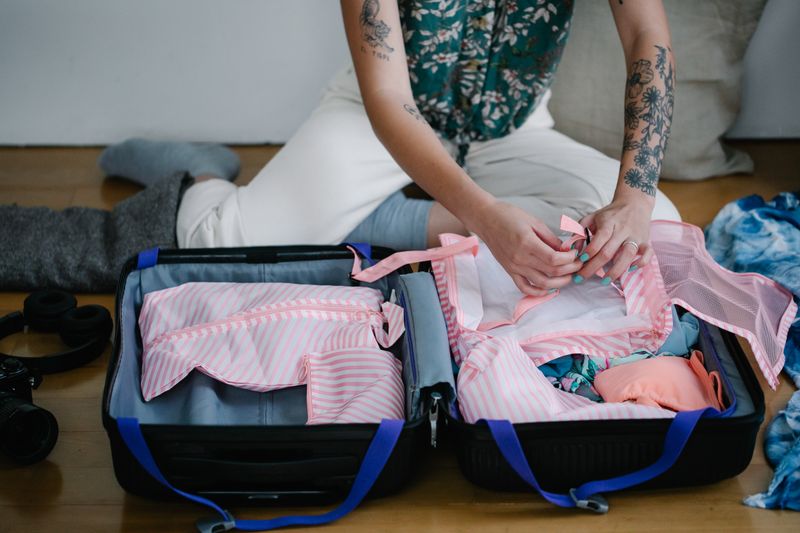
The principle is that anything screening might want should be in an outer compartment or on top, reachable with one hand without disturbing anything else.
Electronics in a single sleeve near the opening, and liquids in one bag rather than distributed, together fix most of the problem.
Cables, chargers and dense clusters of metal read as ambiguous shapes on a scanner, so keeping them together and flat reduces the chance of a second look.
Pockets and the tray
Everything from your pockets has to go somewhere, and the moment before the scanner is a bad time to decide where.
Emptying pockets into the bag before joining the line means one item goes through rather than several loose objects in a tray.
Loose items in trays are also the most common thing left behind, because they are collected under time pressure at the far end of the belt.
Why this matters more on two nights
A short trip is often built around a tight departure, with no spare hour to absorb a delay at the checkpoint.
Queue lengths vary sharply by day and hour, and Friday afternoon and Sunday afternoon are the busiest periods at most American airports.
Questions readers ask
How far ahead is a forecast reliable?
The broad picture holds well over a couple of days and degrades noticeably beyond a week. A two-night trip fits inside the dependable range.
Should I rebook if the weather looks poor?
If the trip is outdoors and the outlook is genuinely bad, moving it usually beats enduring it, which is easier when accommodation terms are flexible.