Travelling Light
What you carry decides how you move through the day
The bag is not just storage. It sets how far you will walk, whether you will detour and how the first and last days work.
This works through the effect of luggage on a day in the order the parts actually depend on each other.
The short version
- A carryable bag makes the arrival day usable before check-in.
- Wheeled luggage limits routes on rough surfaces and steps.
- The last morning is shaped entirely by what you are carrying.
The arrival gap is decided by the bag
Between arriving and being able to drop your things there is usually a gap of some hours. With something carryable that gap is a walk, a meal and a first look around.
With something that must be dragged, it is a detour to the accommodation and back. The same hours produce a completely different trip depending on one decision made at home.
Surfaces decide the wheels question
Wheeled bags are effortless on smooth surfaces and difficult on cobbles, gravel, steps and narrow pavements. Older centres frequently combine all four, which is exactly where short-trip accommodation tends to be.
For most people, street-level imagery of the streets around your base answers this in two minutes. It is a decision about the destination rather than a general preference.
Weight changes route choice
Carrying a heavy bag makes people take transport for distances they would otherwise walk. Each of those decisions costs waiting time and removes the incidental part of the trip.
On two days those small diversions add up to a meaningfully different experience. Lightness buys the ability to keep walking, which is where short trips get their value.
The last morning depends on it
After checkout the bag is with you until you leave, and what you can do is set by how portable it is. A small bag means a normal morning; a large one means finding somewhere to leave it or ending the trip early. This is the single most common way the final hours of a short trip are wasted.
It is determined entirely by a packing decision made days earlier.
Hands and shoulders
A bag carried on the back leaves hands free for tickets, doors, food and children, which matters constantly in transit. A bag carried on one shoulder is fine for twenty minutes and unpleasant for two hours.
Put simply, neither is a rule; the point is that the carrying method determines how long you can comfortably stay mobile. On a short trip, staying mobile is what keeps the schedule.
Judge the bag by the trip, not the trip by the bag
The right amount to carry follows from what the destination demands: terrain, weather, one formal evening or none. A trip that genuinely needs more should carry more rather than suffering to meet a rule. The failure is carrying for a trip you are not taking.
That is a question about the trip rather than about luggage.
The test is a flight of stairs
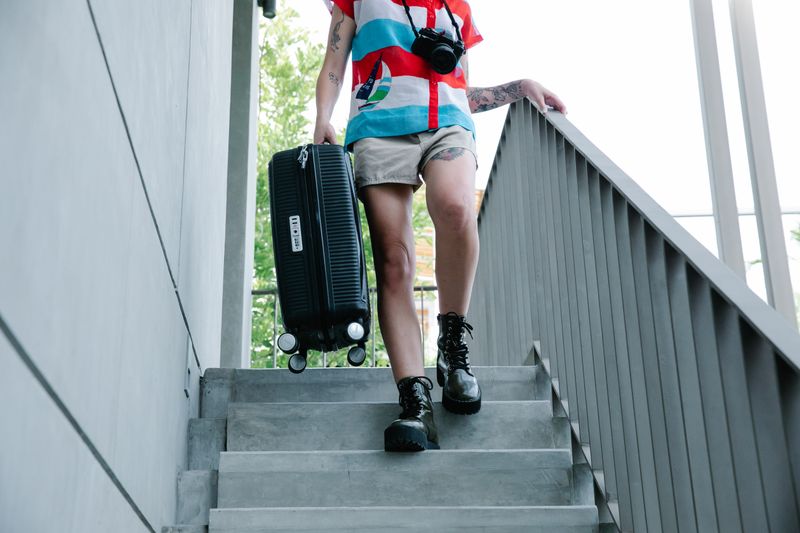
The honest test of a bag is whether you can carry it up a flight of steps without stopping, because stations, older buildings and street entrances are full of them and the lifts are frequently out. Turnstiles, narrow gates and crowded carriages all reward something you can hold in front of you and punish anything that has to be dragged along behind.
The useful part is this: escalators with luggage are where a surprising share of travel accidents happen, particularly going down with a heavy bag and a hand that cannot reach the rail. A bag that passes the stairs test shortens every transfer of the trip, which on a short break amounts to the same thing as making the trip longer.
The takeaway
The bag determines the arrival day, the last morning and how far you walk. Choose it for those.
The version you keep doing is the version that works.
Questions readers ask
Backpack or wheels for a short trip?
It depends on the surfaces and whether you will carry it between things. Rough or stepped streets favour something carried; smooth ones favour wheels.
Does it matter for a two-night trip?
More than for a long one. Short trips have more transit relative to their length, so the bag is with you for a larger share of the time.