Travelling Light
Two people travelling out of one bag
Sharing a single bag for two nights halves the things to carry and doubles the number of decisions to agree first.
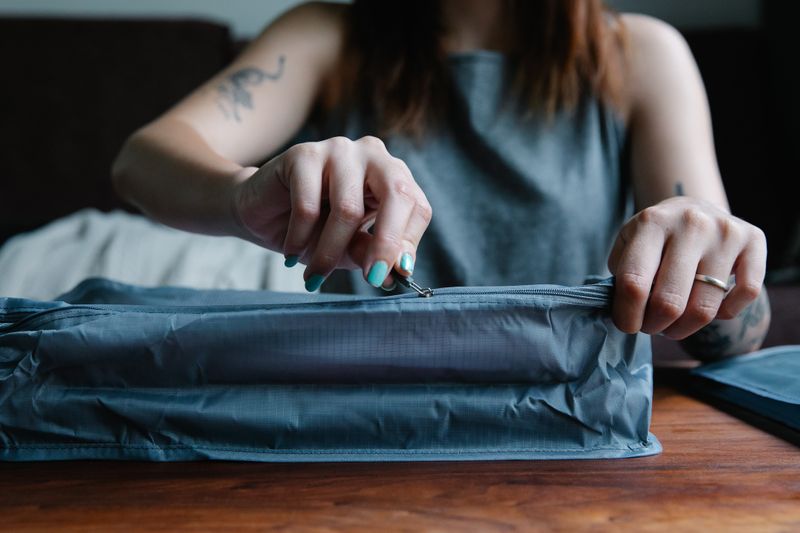
What follows is the working version of sharing luggage: the decisions in the order you actually meet them, with the reasoning attached.
Before you start
- Shared items duplicate easily when two people pack separately.
- One bag means one person carries it, which needs agreeing.
- It only works where both people accept the same volume limit.
Duplication is the obvious saving
Toiletries, chargers, an adapter, a book and any shared equipment are frequently packed twice when two people pack independently. Agreeing who brings what removes an entire category of weight before anything is decided about clothes. This conversation takes two minutes and is skipped almost universally.
It usually removes more volume than any amount of careful folding.
One bag means one carrier
A single shared bag has to be carried by someone, and on a short trip with a lot of walking that is not trivial. Agreeing to alternate, or choosing a bag both people can comfortably carry, prevents an entirely avoidable friction.
On an ordinary week, where the weight is uneven between the people, two smaller bags are often fairer than one large one. The goal is fewer things to keep track of, not one bag as a principle.
It requires an agreed limit
Sharing only works if both people accept the same constraint, and it fails if one packs to the limit and the other has to fit around it. Dividing the space explicitly, rather than by who packs first, avoids that.
This is more about fairness than about logistics. A trip that starts with a resented packing decision starts badly.
Fewer things to lose
One bag means one thing to keep track of in transit, which is a real reduction in low-level attention across a travel day. It also means one thing to store, one thing to carry on the last morning and one thing to check for. On a short trip with several transitions, that adds up.
The simplification is the main benefit rather than the space.
Where it does not work
If the two people separate during the day, having everything in one bag is inconvenient for whoever does not have it. Keeping personal essentials, documents and anything needed individually separate solves this. The shared bag holds shared things; it does not have to hold everything.
For most people, that distinction is what makes the arrangement practical.
It changes what gets packed
A shared constraint tends to produce more honest decisions than an individual one, because each item has to be justified to someone else. That is uncomfortable and it is effective. Most people find they carry noticeably less when the space is visibly shared.
In practice, the effect is the same reason group packing lists work better than individual ones.
Cross-pack when there are two bags
Where two bags are being carried anyway, putting half of each person's clothing into the other's bag means a single delayed or lost bag leaves both people equipped rather than one of them stranded. It costs nothing, takes two extra minutes at the packing stage, and is standard practice among people who travel constantly for work. The same logic applies to the shared items, since an adapter in one bag and a charger in the other is the arrangement that survives one of them going astray.
On a two-night trip it matters more than usual, because there is no time for a delayed bag to catch up with you before you are leaving again.
The takeaway
Agree who brings the shared things first. That is where the volume actually is.
Small and repeatable beats ambitious and abandoned, almost every time.
Questions readers ask
Is one bag for two people realistic for two nights?
For many pairs, yes, once duplicated toiletries and chargers are removed. It depends more on the climate and the trip than on the number of people.
Who should carry it?
Agree before leaving, and alternate or choose a bag both can carry. It is a small decision that causes disproportionate irritation when unmade.