Travelling Light
Living out of the bag rather than unpacking it
Two nights is short enough that unpacking is optional. Whether you do it changes how the room works and how the departure morning goes.

Most explanations of not unpacking stop at the point where it starts to matter. This one carries on.
The short version
- Unpacking spreads belongings across a room, which is where forgotten items originate.
- Keeping everything in one place makes checkout fast and predictable.
- Unpack only what is used repeatedly, and leave the rest where it is.
The instinct to unpack comes from longer trips
On a holiday of a week or more, unpacking makes the room habitable and removes daily friction from getting dressed. On two nights the friction saved is trivial, while the cost of scattering belongings across an unfamiliar room is not.
Every surface used becomes a place something can be left behind, and unfamiliar rooms have surfaces you do not habitually check. The result is that unpacking on a short trip mainly increases the chance of leaving with less than you arrived with. Treating the bag as the storage rather than the transport removes that whole category of problem at no cost.
What is worth taking out
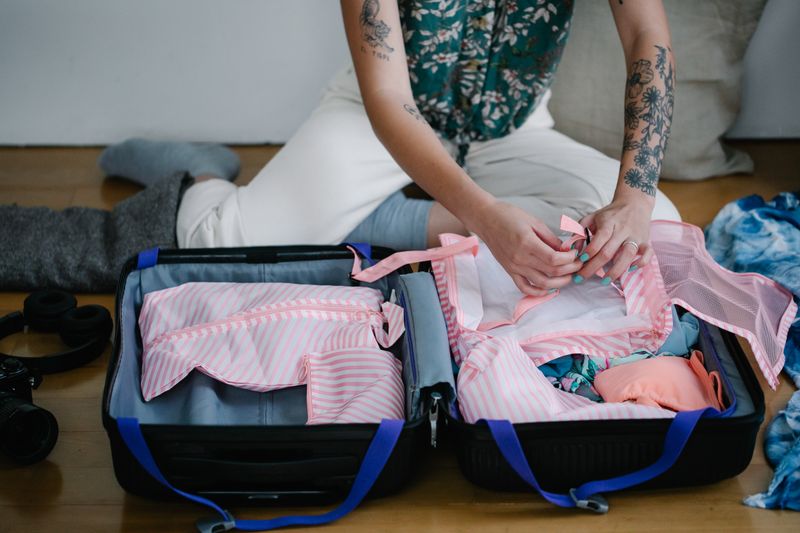
Anything used more than twice a day belongs out of the bag, which usually means washing things and whatever charges overnight. Anything worn on both days is easier hanging up, if only so that it looks like it was not carried in a bag. Everything else stays where it is, and the bag remains packed except for the small number of items in use.
That arrangement also makes the room tidier, which matters in the small rooms that short-break accommodation tends to provide. It is a distinction between things in circulation and things in reserve rather than a rule about packing.
The departure morning
Checkout on a short trip is often early and always on a fixed deadline, and it is the point where scattered belongings cost time. A bag that was never unpacked is ready in a few minutes, which converts a rushed morning into an ordinary one.
Where it helps most, those recovered minutes land at exactly the moment they are worth most, since the departure morning is the thinnest part of the trip. It also removes the low-level anxiety of wondering whether something is still plugged in behind a bedside table. A single sweep of the sockets and the bathroom is then genuinely sufficient rather than a hopeful gesture.
Two people in a small room
The case is stronger with two people, because two unpacked sets of belongings in a small room become indistinguishable within a day. Keeping each set contained means neither person spends the weekend searching through the other belongings. It also makes leaving straightforward, since each bag is its own responsibility rather than a shared archaeological problem.
Put simply, where a room is genuinely small, which is common at this price and this length, the floor space matters as well.
This is one of the few travel practices that reliably reduces friction between people sharing a room.
When unpacking is worth it
A three or four night trip changes the calculation, since the daily friction begins to outweigh the risk of leaving things behind. Somewhere with genuine storage, rather than a corner and a chair, also makes unpacking more attractive and less risky. If the trip involves a formal occasion, hanging things up well in advance is worth the small additional care at checkout.
On an ordinary week, and if the room is the point of the trip, living out of a bag in it rather defeats the purpose of having chosen it. The general rule is that unpacking pays once the number of nights exceeds the number of surfaces you will remember to check.
If that does not fit your week, it is not a failure of willpower.
Moving between two places
Short trips that involve two bases, such as a border weekend or a city plus a night elsewhere, make this decisive. Packing twice in three days is enough friction to discourage the second base entirely, which removes a good trip shape.
On an ordinary week, a bag that stays packed makes moving trivial, which is what makes multi-base weekends practical at this length. It also means the second move can be decided late, since nothing has to be undone in order to leave. That flexibility is worth more on a short trip than the marginal comfort of having everything laid out in a drawer.
The takeaway
Take out what you will use twice a day and leave the rest packed.
Pick the one that costs you least, and let the rest wait.
Questions readers ask
Should I unpack for two nights?
Only what you will use repeatedly. Everything else stays in the bag, which makes checkout quick and removes most of the risk of leaving things behind.
What gets left behind most often?
Chargers in sockets and things on bathroom surfaces. Both are places you do not habitually check in an unfamiliar room.