Short-Break Cities
Industrial Cities And Their Reinvented Waterfronts
Docks that lost their working purpose were rebuilt as cultural and residential quarters, producing a distinct kind of city centre with predictable strengths and gaps.

A great many port and industrial cities now have a redeveloped waterfront, and they resemble each other more than they resemble their own city centres. Knowing why explains what a visit there will be like.
Why the docks emptied
Containerisation moved cargo handling to deep-water terminals with space for cranes and lorries, which existing city-centre docks could not provide.
The old basins were left with substantial buildings, water frontage and no economic function, immediately next to the centre of a city. That combination is unusual and it invited redevelopment.
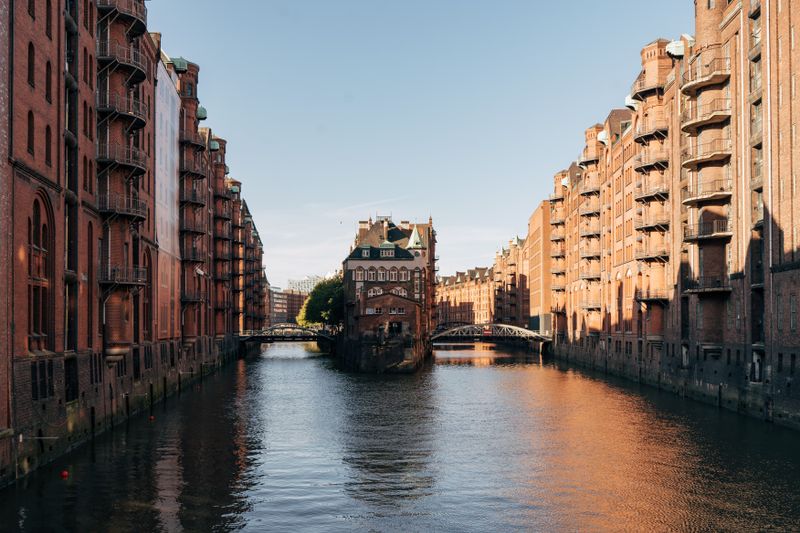
The warehouses survived because they were solidly built and cheap to acquire, which is why so many of these quarters have the same brick-and-iron character.
The redevelopment formula repeats
The pattern is consistent: a gallery or museum as an anchor, apartments in the converted warehouses, restaurants along the water and a public walkway connecting them.
It repeats because it works and because cities copied each other deliberately. The consequence for a visitor is that these areas feel familiar even on a first visit.
They are pleasant and they are rarely surprising, which matters when a two-night trip has room for one area only.
What the waterfront is good at
Concentration is the strength. The anchor institution, several restaurants and a walkable route sit within a small area, so an evening there needs no planning.
They also handle bad weather reasonably well, since the buildings are large and the distances short. Water and weather together are often the point, and a wet evening on a dock looks better than a wet evening inland.
Orientation is easy as well, because the water gives a fixed edge to walk along. A visitor cannot get properly lost in a quarter with one straight side.
What it is missing
These quarters were built at once, for a defined purpose, so they lack the accumulated variety of a centre that grew slowly. The ground floors are mostly hospitality.
Ordinary life happens elsewhere, which means the shops, markets and small businesses that give a city its texture are usually a walk inland.
Prices reflect the same thing. A quarter built for new residents and visitors carries visitor prices, while the equivalent street a few hundred metres away does not.
The rest of the city is the reason to go
The industrial cities that repay a visit do so because of what the industry paid for: civic halls, libraries, exchanges and galleries built when the money was there.
That inheritance is the distinctive part and it sits in the old commercial centre rather than on the water. A two-night visit that spends both evenings on the waterfront sees the version that every such city shares.
Questions readers ask
Which day is usually the closed one?
It varies by country and institution, and there is no safe assumption. Check the specific places you care about for your specific dates.
Are weekends better or worse for a short break?
It depends on the destination. Some places are livelier and some largely shut down. The rhythm of the place decides, not the calendar you are used to.